
The Aviation Industry Is Growing Faster Than Its Infrastructure.
Rapid Deployment Infrastructure: The New Strategic Standard for Civil Aviation
By Gaptek | Aviation Infrastructure Intelligence

Modern MRO facility built for Gaptek. Source: Joramco stock photography.
The civil aviation industry is growing faster than its infrastructure can keep up. Passenger demand, fleet expansion, and increasing maintenance requirements are forcing airports, airlines, and MRO providers to rethink not just what they build — but how fast they can build it.
The pressure is real and the data confirms it: according to IATA, global passenger traffic grew 5.3% in 2025, with international demand rising 7.1%. For 2026, IATA projects continued growth of 4.9%, with passenger numbers expected to reach 5.2 billion — a new industry record. Long-term, global air passenger demand is projected to more than double by 2050, growing at a 3.1% CAGR from the 9 trillion revenue passenger kilometers (RPKs) recorded in 2024.
This sustained growth is not a temporary rebound. It is a structural shift — and infrastructure must evolve with it.
The MRO Capacity Challenge
The global MRO sector is one of the clearest indicators of aviation’s expansion pressure. The global aircraft MRO market was valued at approximately $90 billion in 2024 and is projected to reach between $120 and $145 billion by 2030–2034, growing at a CAGR of roughly 4.75% to 5.2% depending on the segment analyzed (Grand View Research, Precedence Research, Zion Market Research, 2024–2025).

MRO technicians performing engine maintenance. Fleet growth is accelerating demand for skilled maintenance capacity worldwide.
Several forces are driving this growth simultaneously:
- A global commercial fleet backlog exceeding 17,000 aircraft orders, as reported by IATA in late 2025
- Aging aircraft in active service requiring more intensive maintenance cycles
- Accelerating fleet expansion in high-growth regions, particularly Asia-Pacific, Latin America, and Africa
- Stricter airworthiness and safety regulations increasing maintenance frequency requirements
- Aircraft delivery delays pushing operators to extend the service life of existing fleets
The result is a structural gap: demand for MRO services is outpacing the capacity of existing facilities to absorb it.
For MRO providers, airlines, and airports, the question is no longer whether to invest in maintenance infrastructure. The question is how quickly that infrastructure can become operational.
Why Speed Has Become the Core Variable
In traditional aviation infrastructure models, the construction of a new hangar or maintenance facility could take years from planning to operation. In today’s environment, that timeline is a competitive disadvantage.
Aircraft downtime is a direct cost driver. Every additional hour an aircraft spends grounded for maintenance — beyond what is operationally necessary — represents revenue loss for the airline and reduces throughput for the MRO provider. In a market where load factors are reaching record highs (83.6% globally in 2026, per IATA projections), operational efficiency at the ground level has never been more financially significant.
Rapid deployment infrastructure addresses this constraint directly. Rather than relying on conventional construction models that require extended timelines, prefabricated hangar systems allow aviation operators to bring new maintenance capacity online in a fraction of the time.
Real-world examples are already demonstrating this capability. Last year, Gaptek delivered the world’s largest aluminum aircraft hangar for Joramco. The project was completed in nearly half the time required by traditional construction methods, demonstrating how advanced infrastructure solutions can accelerate operational readiness without compromising quality or performance.

Prefabricated structure assembly on-site.
The Operational Case for Modular Hangar Solutions
The adoption of industrialized and prefabricated hangar solutions has accelerated significantly. Industry data indicates that the shift toward modular aircraft hangars has increased by 22% in recent years, with the adoption of prefabricated designs surging by 28% due to their cost-effectiveness and faster installation timelines (Global Growth Insights, 2024).
The operational advantages of rapid deployment infrastructure align directly with the pressures facing aviation operators today:
-
- Reduced Deployment Timelines industrialized hangar systems use prefabricated structural components assembled on-site, compressing construction timelines significantly compared to permanent buildings. This allows airports and aviation operators to respond faster to growing demand, seasonal traffic increases, or urgent capacity requirements.
- Minimal Disruption to Active Operations Construction within active airport or MRO environments creates logistical and safety challenges. Rapid deployment solutions are specifically designed to minimize interference with ongoing flight and maintenance operations — a critical factor for facilities that cannot afford operational downtime during expansion.
- Scalability and Flexibility Aviation demand is not static. Fleet compositions change, operational volumes fluctuate seasonally, and market conditions evolve. Modern modular hangars can be expanded, reconfigured, or relocated to match shifting operational realities — a level of flexibility that conventional permanent structures cannot provide.
- Structural Performance in Demanding Environments Modern rapid deployment hangars are engineered to perform across diverse operational environments: desert airfields, coastal airports, high-altitude facilities, and cold-climate regions. Advanced materials and structural engineering ensure that speed of deployment does not compromise durability or performance.
- Support for Business Continuity Whether during fleet expansions, facility reorganizations, or temporary operational changes, infrastructure solutions that can be deployed quickly help aviation organizations maintain continuity and avoid operational bottlenecks that affect customer commitments and service quality.
Applications Across the Aviation Ecosystem
Rapid deployment infrastructure is not limited to a single type of aviation operation. The flexibility of modular systems makes them applicable across a broad range of
civil and defense aviation contexts:
- MRO hangars: Primary maintenance, inspection, and overhaul facilities for commercial and cargo fleets
- Paint hangars: Specialized facilities for livery application, corrosion protection, and aircraft finishing
- Aircraft storage: Parking and preservation facilities for parked or stored aircraft
- Ground support operations: Covered facilities for ground service equipment, vehicles, and logistics
- Airport logistics and warehouse areas: Support infrastructure for cargo handling, parts storage, and supply chain operations
- Training and operational centers: Facilities for maintenance crew training, simulation, and technical operations
- Temporary operational buildings: Office and administrative spaces that support infrastructure projects or temporary operational needs
This versatility is particularly relevant in high-growth aviation markets, where the range of infrastructure needs is broad and the requirement for speed is consistent across facility types.
The Strategic Dimension: Infrastructure as a Competitive Asset

Aviation infrastructure investment is now a strategic differentiator, not just an operational necessity. (Hangar MRO Joramco)
Beyond operational efficiency, infrastructure investment has become a strategic differentiator in aviation. Airlines, MRO providers, and airports that can expand and adapt their maintenance capacity quickly are better positioned to capture growing demand, attract new airline customers, and absorb the operational complexity that comes with larger and more diverse fleets.
In a market where IATA projects global airline revenues to reach $1.053 trillion in 2026 — driven by 4.9% RPK growth and record load factors — the margin for operational inefficiency is narrowing. Organizations that cannot service their fleets efficiently will face compounding competitive disadvantages.
Sustainable hangar construction is also becoming a factor in infrastructure investment decisions. The adoption of green building practices in hangar development has seen a 42% rise, with solar energy, high-performance insulation, and energy-efficient systems increasingly integrated into new aviation facilities (Global Growth Insights, 2024). For operators committed to decarbonization targets, rapid deployment infrastructure increasingly offers sustainability-aligned options alongside speed and cost advantages.
Looking Ahead: Infrastructure Built for an Adaptive Industry
The civil aviation industry of 2026 is not the same as it was a decade ago. Traffic patterns, fleet compositions, geopolitical dynamics, and regulatory environments are all in a state of ongoing evolution. The infrastructure supporting aviation operations must be capable of evolving alongside these changes.
Rapid deployment infrastructure represents a fundamental shift in how aviation organizations approach capacity planning. It moves the conversation from years-long construction programs to a more agile, operationally aligned model — one where new maintenance capacity can be brought online within months rather than years.
As the global aircraft order backlog continues to be worked down and fleet expansion accelerates, the demand for MRO capacity will only intensify. Organizations that invest now in flexible, scalable, and rapidly deployable infrastructure will be structurally better positioned to absorb that demand — and to serve their airline customers more effectively in an increasingly competitive environment.
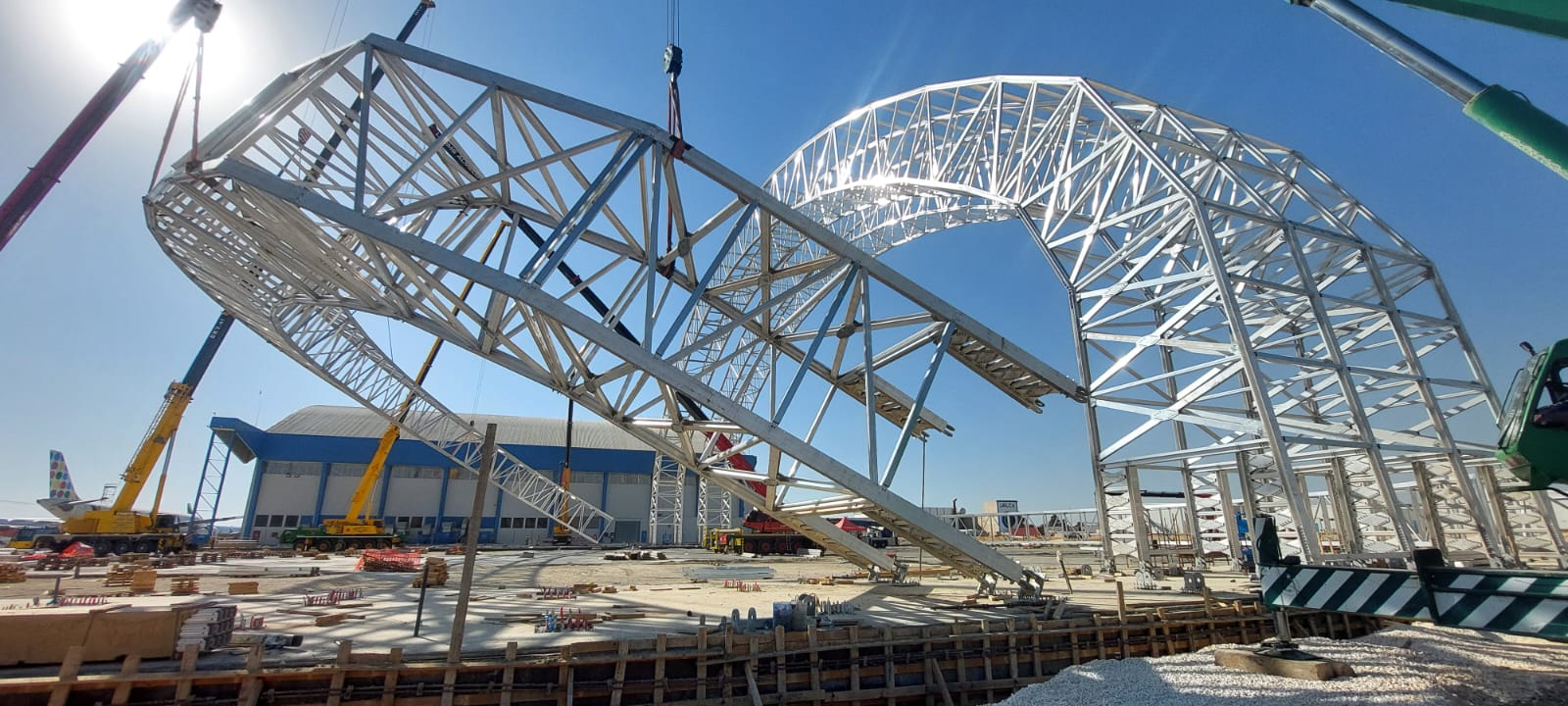
On-site assembly of prefabricated structures with the Gaptek system.
About Gaptek
Gaptek specializes in the design and delivery of rapid deployment aviation infrastructure, including MRO hangars, paint hangars, and airport support facilities. We work with airlines, MRO providers, airports, and defense operators to deliver flexible, high-performance infrastructure solutions that align with the operational realities of modern aviation.
Content owned by Gaptek.
Layout by the Gaptek Marketing Department.
Copyright 2026.

solutions
- Hangars
- Military bases
- Warehouses
- Shelters